
What Size Refrigerator Do I Need?
Two questions decide which fridge to get, and people usually answer them in the wrong order. First, how much food do you actually store? Second, and this is the one that bites: what will physically fit the space you have? A fridge that's perfect for your family is useless if it won't clear the cabinet above it. Here are the real dimensions, the clearances most people forget, and a quick way to measure so you only do it once.
The short answer
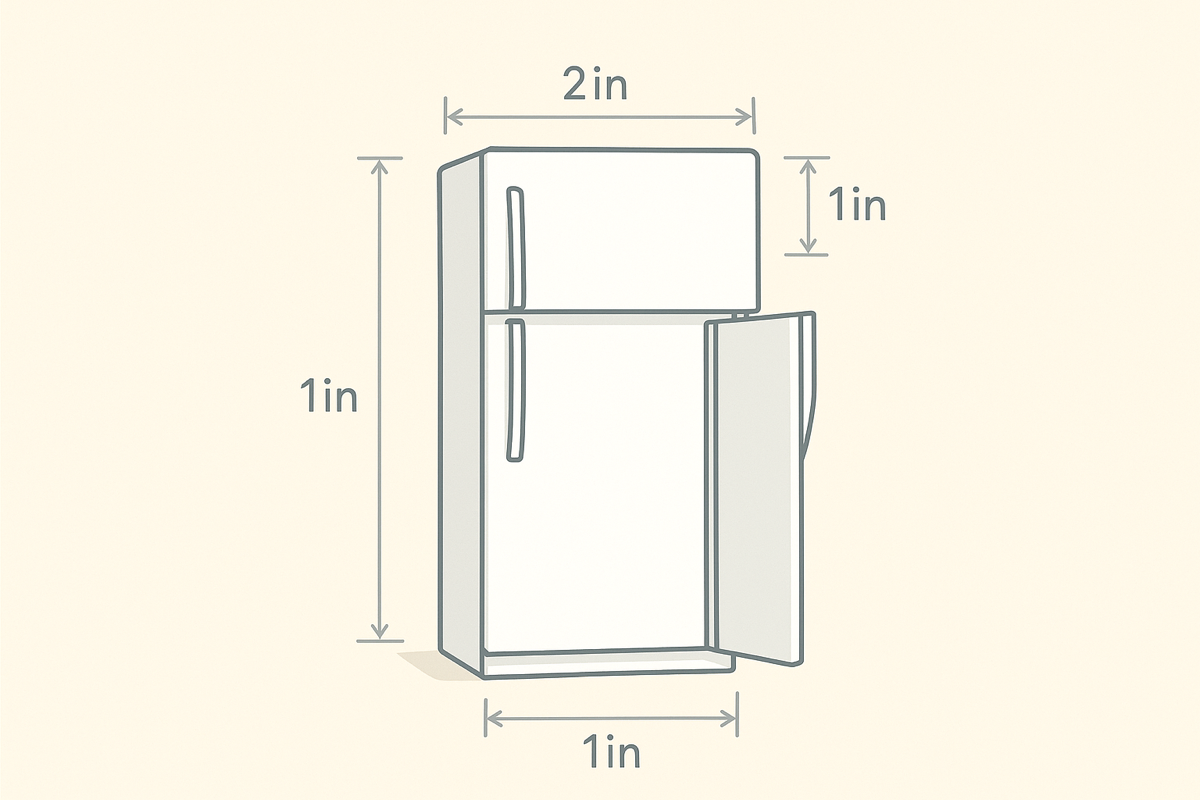
Size a fridge by your household first, then check it against your space. A good rule is 4 to 6 cubic feet per person. Most full-size refrigerators are 28 to 36 inches wide, 28 to 34 inches deep, and 66 to 70 inches tall. Add about 1 inch on each side, 1 inch at the back, and 1 to 2 inches on top for airflow and the power cord. If it sticks out past your counters, look at a counter-depth model.
Refrigerator capacity by household size
| Household | Capacity you'll want |
|---|---|
| 1-2 people | ~18-20 cu ft |
| 3-4 people | ~20-25 cu ft |
| 5+ people | 25 cu ft or more |
| Apartment / dorm / backup | ~10-18 cu ft (or a compact under 10) |
That's a starting point, not a rule. If you cook a lot or shop weekly, size up. If you eat out often or the space is tight, size down.
Standard refrigerator dimensions by style
| Style | Width | Depth | Height |
|---|---|---|---|
| Top-freezer | ~28-32" | ~30-34" | ~62-70" |
| Bottom-freezer | ~29-33" | ~33-36" | ~67-70" |
| Side-by-side | ~32-36" | ~29-31" | ~66-70" |
| French-door | ~30-36" | ~29-34" | ~68-70" |
| Counter-depth (any style) | ~30-36" | ~24-30" | ~67-71" |
| Compact / mini | ~18-24" | ~20-26" | ~33-44" |
Check the spec sheet for the exact model. These are typical ranges, not promises.
The clearances people forget
- Sides (~1"): the doors need to swing open past 90 degrees, or you can't pull the crisper drawers out. A fridge jammed into a corner is a daily annoyance.
- Back (~1"): the coils and power cord live here. Push it flat to the wall and you can crush the cord and trap heat, which makes the fridge work harder.
- Top (1-2"): heat rises off the unit and needs somewhere to go. A tight cabinet above is the most common reason a fridge won't fit.
- Counter depth: a standard fridge that's 34" deep will stick out several inches past a 24" counter. If that bugs you, counter-depth sits flush.
Quick-fit checklist
- Measure the opening: width, height, and depth, including the cabinet above.
- Subtract the clearances: ~1" each side, ~1" back, 1-2" top.
- Pick a style and capacity that fits what's left.
- Check the door swing, especially against a wall or in a corner.
- Measure the path in: front door, hallways, and any turn the fridge has to make.
Common mistakes to avoid
- Measuring the fridge, not the opening. The opening is what limits you.
- Forgetting the cabinet above. Height is where most fridges fail to fit.
- Ignoring the door swing. A fridge can slot into the space and still be unusable in a corner.
- Buying the biggest one you can afford. A 25 cu ft fridge half-empty just costs more to run.
Rent a refrigerator that fits your space
If you'd rather not measure, buy, and haul a fridge you might outgrow next lease, Appliance Rentals rents top-freezer and side-by-side refrigerators with no credit check and free delivery and setup. Give the team your opening and clearances and they'll bring a fridge sized to fit. Want the numbers? See the cost of renting appliances in 2026.